Thanks to all the Factiva users who dialed into the Content Chaos presentation today and to those who asked questions. If you have other questions, please feel free to email me or post them here.
I'd love to hear opinions -- dissenting or supportive.
Also, we're working on getting a recording of it out to those who need help falling asleep at night.
Cheers
Glenn
Tuesday, January 31, 2006
Managing "Content Chaos" via Text Mining Presentation


Tuesday, January 24, 2006
Blogging Allows Marketers to Start Conversations
Alexandra DeFelice reports in CRM Magazine (Jan 1) that marketers at large companies are starting to take more notice of the Blogosphere and how it may change their jobs. And she talks about how marketing could start moving toward having a "meaningful" dialog with consumers. But the industry is not there yet. She reports that Ray Valdes, a Gartner analyst said:
Less than 5 percent of the Fortune 1,000 is using blogs strategically, but that percentage will triple in the next two years... however, even companies that are using blogs are not necessarily using them efficiently at this point... A lack of knowledge and a fear of the risks and repercussions are stopping companies from developing a blogging policy.
Wednesday, January 18, 2006
Most U.S. PR Professionals See Blogs as Important
I missed this study on blogs from Peppercom at the end of last year, but it's worth noting. They surveyed 900 U.S. PR professionals and found :
- 80% feel a corporate blog can help improve the dialogue between a company and its stakeholders
- 79% feel a corporate blog can help position a company and/or its "chief blogger" as a thought leader
- 62% state the blogosphere is an appropriate venue for corporations to communicate with stakeholders
Venture Chronicles: Who is reading blogs
Here's a very good post on why CMOs should care about blogs. I especially like:
the people these decision makers [CMOs] rely on for influence are reading and reacting to blogs, therefore business decision makers are being influenced by blog (sic) if only by a degree of separation.
Nielsen Strengthens Web Buzz Monitoring Position with BuzzMetrics, Intelliseek Deal
It's not surprising to see a media monitoring giant like VNU (owner of well-known Nielsen) entering the rapidly growing Web-measurement market.
This deal probably means that Nielsen BuzzMetrics moves ahead of Biz360 and Umbria on the revenue leader board.
Monday, January 16, 2006
Mining Bird Flu Data
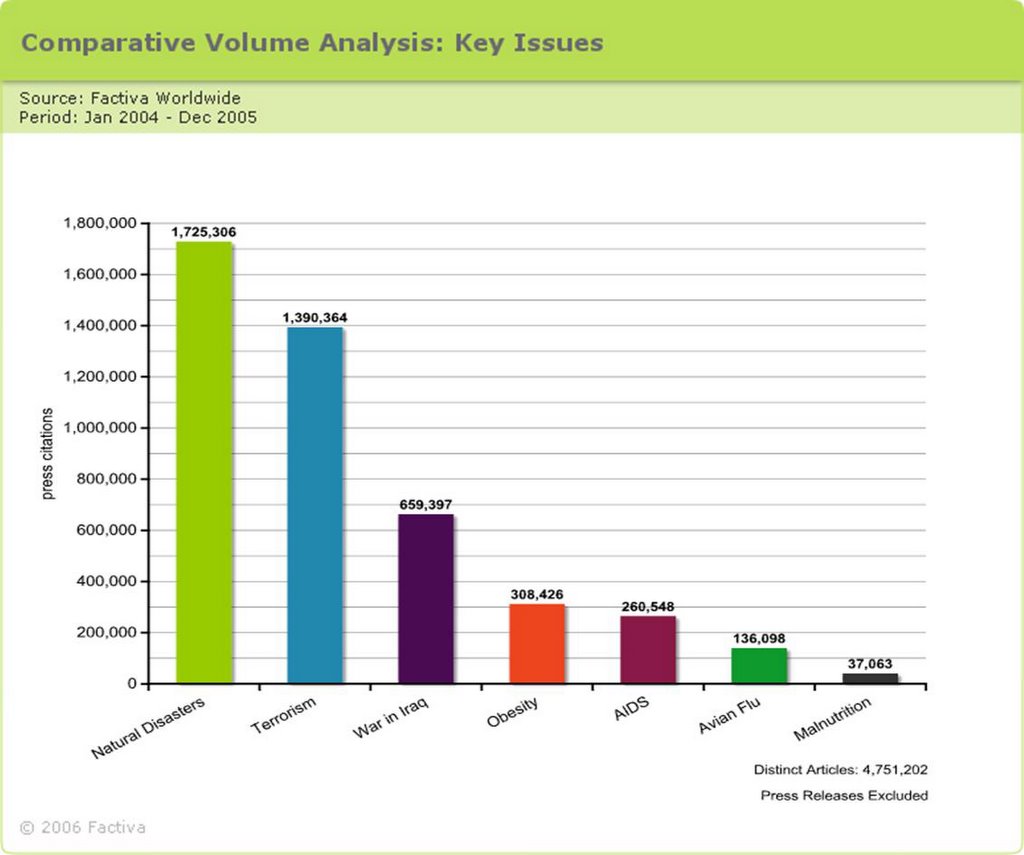
Here's an interesting example of text mining news coverage.
A recent analysis by the Factiva Reputation Lab (TM) shows that while bird flu may be a very serious issue of concern to the entire world, it's not getting the press coverage of other issues. For the past two years it has (not surprisingly) been dwarfed by coverage of natural disasters, terrorism and the war in Iraq. But it's not even reaching the coverage of obesity and AIDS.
Tuesday, January 10, 2006
New Blog Being Written From the Hart
I would be remiss if I didn't mention the entry into the Blogosphere of one of our industry's leaders -- Clare Hart, Factiva's CEO. I'd be remiss because she is a powerful figure in the industry who's voice SHOULD be in the Blogosphere (And I'd be in trouble if I didn't mention it because she's my boss! Kidding, Clare.)
In From the Hart, Clare will likely be giving her perspective on the information industry -- where she sees trends going and how Factiva will strive to be leading the way in many of those cases.
We at Factiva hear Clare's take on things routinely, certainly, but I think it will be great to see her comments in the public space to see how other's perceive her views.
Monday, January 09, 2006
PR Innovation of the Year Finalists Announced
I'm pleased to say that the product my colleagues and I have been working on for a while, Factiva Insight: Reputation Intelligence, has been named a finalist by PR Week in its Innovation of the Year category.
Thursday, January 05, 2006
Here's a CIO Who Gets It
Right now it's pretty rare to see executives blogging. I suspect it's because many haven't realized the value of the tool and many others haven't carved out the time in their schedules to do so. Will Weider, the CIO of Affinity Health System and the author of The Candid CIO is one who gets it.
My guess is that it's just a matter of time before he's joined by more professionals who will realize they can use this medium as a way to increase visability for themselves and their companies. Cheap publicity, if you ask me.
Wednesday, January 04, 2006
Today's News Bounces through MSM-New-Media Echo Chamber
An op-ed in the 2 Jan 06 U.S. edition of PR Week points out that new media must factor into PR managers' strategies.
Paul Bergevin, president of Citigate Cunningham, states:
It seems pretty clear that today's important stories bounce up and down in an echo chamber of cross-reference between traditional and nontraditional media. What happens in the grass- roots or the word-of-mouth blogosphere informs the major media - and vice versa. The most important stories are the ones that are, in fact, a product of the interplay between traditional and nontraditional media.
Harnessing and managing the storytelling between traditional and nontraditional media outlets is the real job of today's PR pro. This is an incredible opportunity for PR to have an even greater influence in the future than it has enjoyed in the past.
Tuesday, January 03, 2006
C|Net: Why companies monitor blogs
Another article (this one from CNet) on what's becoming more and more obvious -- that companies ignore blogs at their own peril.
Tuesday, December 27, 2005
Adweek: 20% of Blogs are Spam
According to a blog research company, Adweek reports, about 20% of the reported 80,000 blogs created every day are fake. Sometimes it's hard to tell which 20%.
Friday, December 16, 2005
Next step in text mining
Earlier this week I spoke to a group of knowledge workers, called KM Chicago, about the subject of using text mining and visualization as a way to manage the vast amounts of content that business searchers need to wade through. President Jack Vinson kindly just posted about my presentation.
KM Chicago is "Factiva-friendly" but not necessarily made up exclusively of Factiva customers. I'd like to thank one of the directors of KM Chicago, Ann Lee, for inviting me to speak. Ann is a colleague of ours in Factiva's Chicago office.
Blogging and your Corporate Reputation
Factiva has published two white papers this week about how public relations and marketing professionals use blogs and how companies can contribute to this new global "conversation."
PRWeek UK Looks at the Best and Worst of Corporate Reputation in 2005
PR Week UK's annual piece on corporate reputation, titled: The Reputation Rollercoaster, written by Adam Hill, is a good overview of the year's winners and losers in corporate reputation.
Mr. Hill made use of some data our team in London extracted from Factiva Insight. Specifically he shows how Sainsbury's media coverage and its stock price "show remarkable symmetry" during 2005.
Tuesday, December 13, 2005
Text Mining Becomes Sexy
As if things were boring around here, I think Amazon just shook up the world of information retrieval. Its mostly quiet Web-search division, Alexa, is opening the doors to its huge trove of Web-crawled content, allowing text-mining access to the archive. It would seem to me this is text-mining for the little guys -- an affordable way to build applications without having to host billions of documents.
The company plans to make it available at a low price point so that just about any developer who wants to can "search and process billions of documents -- even create their own search engines -- using Alexa's search and publication tools. "
Oh my, GYM just got a wake-up call.
Can little Alexa (with big parent Amazon) do what Google hasn't gotten around to yet or that IBM's WebFountain project has been trying to do for years -- make the Internet one big text-minable database that's easy to use and can produce commerical-grade business information tools? It's too early to tell, but it's all very exciting and should be great watching it unfold.
Tuesday, December 06, 2005
IM2005? Maybe Next Year.

Last week, several of my colleagues from Factiva and I attended the IM2005 awards along with 1,300 of our closest business friends. The intimate affair, held at The Grosvenor House Hotel in London was one of the many awards ceremonies in the IT industry. If you've never been to such a black-tie industry event, picture the Oscars -- but without the celebrities, or the press, or the sexual energy, intrigue, anticipation, dynamism, humor, well you get the picture.
The IMmies (I just made that up) didn't have Billy Crystal, but it did have Barry Cryer, who was said to be back by popular demand. Uh, huh. The IM Web site says he's quite the go-to guy in British comedy, having written for "practically every top U.K. comedian". Maybe his humor just doesn't track well to an American's ears, but I'd have to say some of it sounded more like Borscht Belt, circa 1955, than something written for hip dotcom professionals.
And hip it was. When a project called "Mapping Access Land in England" sweeps the night, winning two awards, you know you're with the "in" crowd.
Oh, did our sleek, hip product, Factiva Insight: Reputation Intelligence win in its category "Product of the Year"? No, but we were up against 29 other products (none of which I'd ever heard of). Hats off to Njini. (Who?)
Well, it is an honor just to be nominated. And the spiced confit of Norfolk duck was good. And I'm usually more of a Long Island duck guy. We missed out on the dancing afterward, as we did split right after the awards portion (16 awards in 30 minutes! definitely not the Oscars) and high-tailed it to Factiva's holiday party. We arrived 4 hours into Factiva's 9-hour fete without a trophy but were welcomed back with glasses raised. We're all winners.
Wednesday, November 23, 2005
Wanted: Corporate Blog Writer
So is the idea of a company hiring someone in the role of "corporate blogger" a passing fad or something many well-established companies will be looking to in the coming years. Seems to me the idea is both bizarre and fascinating. Why would a company hire someone and give them supposed free-reign to talk about the goings on behind the cubicles? Ten years ago the idea would be heresy, but in the fast-pased "new" business world, it seems perfectly logical.
I think this position really works well if the conditions are right: 1) Blogging has to fit the corporate culture (Think: a company which embraces business casual 5 days a week). 2) The company has to be innovating in ways that their potential customers find interesting (who wants to read about chewing gum) 3) The blog does not look, feel or sound like it's written by a committee or by the Marketing Department.
I applaud companies who have tried it as an official position (Stonyfield Farm, GM) or who have allowed it to go on in a more unofficial way (Scoble at Microsoft). I'd like to see more companies take the plunge.
If this is all in place, it sets the company up in a position of thought leadership, drives traffic to its Web site, supports its initiatives and gets the attention of the media. Hey, wait, that sounds like Marketing's job. Maybe so, but at the same time, this could be marketing that works.
Tuesday, November 22, 2005
Score Another one for Joe Q Blogger
Score another one for Joe Q. Blogger working hard to keep another company honest.
This time it was security researcher Mark Russinovich who first reported earlier this month that some of Sony's new music CDs were monkeying around with a Windows "rootkit", helping Sony to prevent copying of the music -- and opening up users' PCs to potential security leaks.
Information Week has a good piece on the news, including this stinging summary:
"Sony made an unpopular product decision and got its reputation incinerated by
waves of flaming bloggers. That's a lesson for other companies."
Sony indeed made a mistake when they tried to brush this off. Why not just take your lumps on day one. "We screwed up, we're pulling the CDs. And we'll make this right." That's the way to go. But during a Morning Edition interview on NPR on Nov. 4, the Sony exec interviewed tried to say that this problem was an esoteric technology thingy that the average person wouldn't care about. "Most people don't even know what a rootkit is so why should they care about it?, " he said. That arrogance hasn't played very well. Hundreds of bloggers have ripped Sony for this. Sony's users might not care about the details of a rootkit but they do care about privacy and their computer's security.
You'd think by now a company with the smarts of Sony would see the potential downside of trying to sneak one by. But oh, the bloggers are watching you...
Marti Hearst: Why are you always No. 1?
I have nothing against Marti Hearst. I met with her once a few years back on the campus of UC Berkeley where she teaches in the School of Information Management Systems. And while this document is a good overview of text mining, I can't figure out why Google has ranked it as the No. 1 hit for the search "text mining" for at least the past two years.
Subscribe to:
Posts (Atom)

