Wednesday, December 20, 2006

PR News Online — Measuring Corporate Reputation, Part II: Unrolling The Road Map, Reaching A Goal

Here's a nice summary of one approach to corporate reputation measuring from the folks at PR News Online. Many of the typical points we talk about are mentioned (clearly agree on and define your objectives, techniques and metrics). The article concludes that reputation management is more of an art than science and is imperfect but that "the numbers it provides are just as good as those offered by, say, the marketing department." And adds this metaphore.

Have you ever heard the story of the two guys in a tent contemplating the bear
outside? As one laced up his shoes to make an escape, the other looked on in
disbelief and said, 'What do you think you're doing? You can't outrun a bear.'
The other just smiled and said, 'I don't have to outrun the bear. I just have to
outrun you.'

Sunday, December 10, 2006

Nine Hours Ahead

I just barely had time to unpack after the Factiva Social Media Roundtable trip to Palo Alto and I am off again -- this time to Germany and France to talk about media measuring in Europe.

We are holding a customer roundtable in Frankfurt on Wednesday. No bloggers at this one. It's more of a chance for Factiva to talk to our customers and prospects about media monitoring and about the new world of social media. My hunch is that Europe (I know it's dangerous to generalize) is a couple of steps behind the States on putting together corporate action plans on monitoring social media. It seems that outside of a few industries and locales in the States who already get it, much of rest of the U.S. is about 6 months behind. So I suspect Europe is 6-12 months behind that.

I'm eager to hear feedback on Wednesday to see if I'll be surprised or not.

An Aside (and generating my own customer content): Kudos to Continental Airlines who wisked me off my delayed flight into Berlin and onto my connecting Lufthansa flight. They met me at the door of the plane, ran me to a waiting car and we zipped across the tarmac -- but too bad they couldn't get my bag to my second plane as quickly. (Huzzah to Lufthansa, who several hours later brought it to my hotel.)

Wednesday, December 06, 2006

The Day After -- My Head's Still Spinning


My head is still spinning from last night -- and not from the wine. There is simply so much to digest after a night with two dozen people who spend a lot of time thinking about the meaning of social media.

What I'm saying is the Factiva Roundtable we held last night in Palo Alto was a success. Just about everyone in the room seems completely engaged and continued the conversations through drinks and dinner. Jeremiah Owyang, our guest emcee from PodTech, did a wonderful job and has written an amazingly complete post within hours of the event. He also managed to take some wonderful photos.

Huge thanks to Daniela, who took on this project with gusto because she just loves this stuff. Thanks also to Matt Toll, Saurabh Goorha and Sally Hammond, the others on our little team, for the hours they put into preparing for the event.

We are going to be working quickly to create some outputs from this -- white paper, blog posts, podcasts, etc. More on that soon.

Tuesday, December 05, 2006

Social Media Roundtable Attendees

As I stated previously, we're expecting 23 thought leaders at the Factiva Social Media Roundtable today in Palo Alto. With the 6 of us leading the event, we've maxed out the room. The intent was always to keep this intimate. Daniela created a wiki and asked the attendees to post their names if they wished. Respecting those wishes I only list those who did so to date:

  • Andrew Lark, Founder, group lark www.grouplark.com
  • Ed Terpening, VP Social Media, Wells Fargo, Wells Fargo Blog Index
  • Christopher Kenton, MotiveLab, www.marketonomy.com
  • Jeanette Gibson, New Media Communications, Cisco, http://newsroom.cisco.com/, http://blogs.cisco.com
  • Brian Solis, FutureWorks PR, http://www.future-works.com/ / PR2.0, www.briansolis.com
  • Ian Kennedy, Product Manager, Yahoo, flashpoint
  • Jeremy Pepper, Social Media, Weber Shandwick / POP! PR Jots
  • Jory Des Jardins, Co-Founder, BlogHer, LLC; www.blogher.org
  • Mike Manuel, Strategist, Voce Communications, Media Guerrilla
  • Andrew Vignolo, Director, Market Trends & Analytics, Levi Strauss & Co.
  • Jeff Beckman, Director, Worldwide and U.S. Communications, Levi Strauss & Co.
  • Tony Obregon, Director of Social Media, Cohn & Wolfe

The attendees are a mix of PR/measurement practitioners, independent bloggers and social media thought leaders.

The Questions: Should social media be measured by business?

Daniela Barbosa (Factiva integration sales), Saurabh Goorha (Insight product manager) and I met for dinner with Jeremiah Owyang and John Aguilar of PodTech last night. The intent was to prepare for the Factiva Social Media Roundtable which is taking place in a few hours in Palo Alto.

(Jeremiah is just settling in at his new job at PodTech and you can tell he's jazzed because he can now focus all of his efforts on social media -- clearly where his heart is. )

Here are some of the questions we are going to be asking our slate of 23 social media thought leaders:

  • Do you believe social media is important to the business community? If so should it be measured?
  • Who is creating Social Media? What are they creating? And is the who more important then the what?
  • If you are producing Social Media as part of your PR/Marketing plan, how will you measure ROI?
  • Do you think that Social Media needs a structured, mutually agreed upon measurement techniques and metrics (e.g. MSM's ad value equivalence and article impressions) to make monitoring a more serious practice?
  • So what should be measured, and how do you want it delivered?

Wednesday, November 22, 2006

Do your colleagues still tilt their heads when you say 'social media'?

Here's a concise overview of "social media" from Spannerworks, an SEO company. The PDF is somewhat basic, but it's a nice tearaway to hand to your colleagues who still tilt their heads when you talk about "conversations" that don't happen face to face.

Thursday, November 16, 2006

Factiva's First Social Media Roundtable

A few months back several of us in the Product Development group at Factiva got into some conversations with Jeremiah Owyang, then of Hitachi Data Systems, about social media measurement. (Jeremiah has since moved on to Podtech.)

The conversation started around a product of ours, Factiva Insight, that Hitachi is using. Jeremiah basically told us, (paraphrasing) "hey, the product is pretty impressive, but it doesn't really suit my particular needs in the measurement of social media." We thought we were doing a pretty good job but we were open to hear about why Jeremiah disagreed.

Those discussions, helped greatly by the coolest Factiva employee, SF based Daniela Barbosa, grew into the idea that we should hold a roundtable event and learn from those who are in the social media what we could be doing differently and what the state of the social-media-measurement space is.

So, Dec. 5 at Zabbio in Palo Alto about five of us lucky folks from Factiva and 20 or so big brains in social media will spend a few hours chatting about where social media measurement is going.

It is an invitation only roundtable with no audience. But we will produce from it stuff like a podcast, video clips and a paper of some sort (which the always witty Matt Toll has promised will be spectacular -- no pressure).

Daniela and Jeremiah , who's agreed to emcee the event, have already been posting about it (I've been under water with my real job, not that they're just sitting around, I know.)

But I'm going to try to catch up and post some of the questions here that we will be throwing out to the participants. This will give people a chance to start a discussion online before and after the event.

More soon.

Friday, November 10, 2006

MSM Just Keeps Taking Blog Prophets' Word for It

Michael S. Malone writing on ABC News's Web site has taken Technorati's word for it that the Blogosphere is N big. Technorati says 57 million blogs? OK, the number must be 57 million. 100,000 new blogs a day? 1 billion bloggers by 2010? Yup, they must be right.

Nowhere is the question that these numbers are at best only part of the story and at worst an exaggeration. How can you not even mention all the blogs that are created one day and abandoned the following week? Or the fact that many bloggers have multiple blogs? Or all the spam blogs that get counted as real blogs? It's lunacy.

57 million blogs ever created hardly equals 57 million people now blogging.

The number of active bloggers is growing and it's probably an impressive number but there are lots of caveats to those numbers and to understand their meaning the MSM has to ask questions. Remember J-school guys?

Thursday, October 05, 2006

Lexis-Nexis Survey Shows News Still Comes from the MSM

I hope Lexis-Nexis didn't spent too much money on
this survey which revealed that people don't turn to blogs to find out about breaking news.

I'm not sure why that question is even being asked. Is L-N feeling that threatened by new media? Do people really believe that bloggers are going to replace journalists? With few exceptions, bloggers aren't going out there interviewing sources, working beats, going to press conferences, running to crime scenes and working a Rolodex(TM) (did I just date myself?). Bloggers are performing analysis of the work that journalists do.

They say that journalists write the first draft of history. Bloggers, it seems, are now writing the second.

Tuesday, October 03, 2006

ROI of Blogging from Forrester


Charlene Li, an analyst at Forrester, presented a Webinar today on the ROI of Blogging. Some of it was basic, at least for those who are at all familiar with corporate blogging, but she is an excellent presenter and made some good points:

-- Successful blog management requires measurement.
-- Recruitment blogs can be a very obvious place for companies to start blogging because hiring is all about reaching out to people -- and that's what blogs are all about.
-- Be honest with yourself about the potential risks your new corporate blog could have and put a risk management plan in place ahead of time.
-- When calculating ROI, remember that blogs have all different purposes (customer service, recruitment, loyalty marketing, product marketing, branding, sales gen, community relations, investor relations, etc.) so you have to start by outlineing your goals before you can measure success.

One note: The Webinar was hosted by Cymfony, a message measurement company which recently received top grades from Forrester's Brand Monitoring Wave report. I'm not saying there is any quid pro quo here, but it seems Forrester is just asking for raised eyebrows when it puts its name next to a company that was a focus of one of its reports. Full disclosure: Factiva Insight was also rated in the same report (and scored less well than Cymfony).

Monday, October 02, 2006

Netflix offers $1 million for a better review | CNET News.com

Pretty interesting look into how
Netflix is looking to improve its results.

Exploding Batteries Hit Different Companies at Different Times


This analysis from Factiva Insight shows how discussion of the issue of the exploding laptop batteries hit different companies (Dell, Apple and Lenovo) at different times

Friday, September 29, 2006

Web 2.0 Media Acknowledged at PR Conference

Jim Macnamara, Chairman and CEO of CARMA International, the last speaker of the IPR measurement conference ended his comments with a sentiment not expressed by too many others during the 1 1/2 day meeting. Namely that Web 2.0-based communications such as blogs and wikis, he said, represent a fundamental change in communications because they are a two-way conversation. "It's only matter of time before we see [something such as] 'Wikinews' dwarf" the major media outlets of the world in impact, he said.

Such communications media are rewriting the rules of PR and media relations with new networks of communicators and connections being created, he said.

Bridging versus Buffering

Jim Grunig, professor emeritus at the University of Maryland, talked about where PR measuring has been and where it's going.

Grunig spoke about PR as a strategic management function not a messaging, publicity and media relations function.

He also talked about the concepts of Bridging (the public relations approach focused on interpersonal relationships) vs. Buffering (the mass marketing/advertising approach) to PR. More can be found in a paper he authored. The bigger the organization, he said, the more likely they were to use the latter, less-personal, more advertising-centered approach to PR.

Media Measurement Can be Tied to Financial Outcomes

Day two of the Summit on Measurement conference started with a case study from United Technologies and its study on measuring media relations messaging on financial outcomes.

The areas of communications that they rate themselves on include: Employee Relations, Customer Relations, Management Strength, the CEO, Corporate Culture, Brand and General Communications, Innovation, Capital Structure, and Cost Control.

They measure tangibles like financials and intangibles like leadership, human capital, technology, reputation, familiarity, favorability etc.

One side comment made that I found interesting: According to Jon Low, a partner at Communications Consulting Worldwide, the company who authored the study, "CEOs are enamored with innovation, but we've found that it's not a factor in [the company's] revenue growth;" it is the second lowest factor, he said.

8 Methods of Content Analysis

Inspired by the measurement bug, I was looking through some earlier notes of mine and came across this list of "methods of content analysis" originally published by The Institute for Public Relations. The list is theirs; the notes are mine.

1. Clip Counting (volume counts) -- called the "most basic and perhaps most antiquated"
2. Circulation and Readership Analysis -- reported in "total circulation" or "total readership and includes number or readers, demographic profiles of readers and other lifestyle data
3. Advertising Value Equivalence (AVE) -- reportedly the dollar value of media impressions based on how much it would cost to take out an ad in the publication where the article was published. It is said to be "generally discredited by PR practitioners and leading researchers" however the PR folks I've been talking with all say their clients often ask for it and they give 'em what they want.
4. Simple Content Analysis -- counts of documents about certain topics
5. Message Analysis -- counts of documents that include specific messages
6. Tonality/Sentiment/Favorability Analysis - assessment of the entire article and individual messages in the article
7. Prominence Analysis -- Importance of the hits based on publication name, day of the week, word count, location of article in publication, presence of art work, size of headline. Each element gets a weight and roles up to a score for the article
8. Overall Quality of Coverage -- combination of tonality, prominence, message inclusion and volume counts

Thursday, September 28, 2006

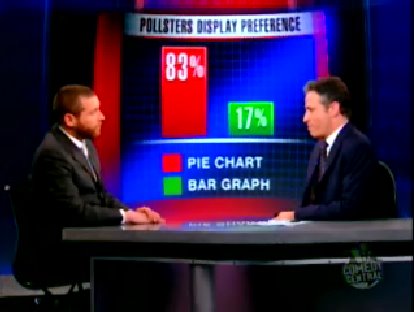
People like Pie charts

Here's the answer to the proper way to decide on how to visualize data. (Note: This link takes you to Comedy Central, which seems to make you click again on the video in the playlist on the right. Annoying)

Attendees at the Summit on Measurement

The 100 or so attendees at the Summit on Measurement conference could be broken down into the following groups: 1) PR agencies (DeVries, Fleishman Hillard, Ketchum, Millward Brown Precis, Ogilivy, Overkamp, Porter Novelli, RF Binder, Roper, MWW, KDPayne); 2) measurement vendors (Biz360, BurrellesLuce, Carma, Cyberalert, Cymfony, Delahaye, Echo Research, Factiva, PR Newswire, VMS) 3) end-users (Cephalon, E&Y, DaimlerChrysler, Florida Dept of Agriculture, GM, The Hartford, MetLife, Nortel, Shell, Southwest Airlines, Raythenon, Rockwell, United Technologies, SoCalEd, and several colleges and universities 4) academics

P&G Case Study Purports to Show PR ROI Beats other Methods

Mark Weiner, President and CEO of Delahaye, Bacon's presented a case study focused on PR
marketing mix modeling
(MMM) about a P&G new-product release in which he said the PR spend on the product had the best ROI of the four types of spends. For every dollar spent, the following sales were generated, he said: TV ($1.31), trades ($2.13), price promotions ($0.78), PR ($2.70). I'm not entirely clear how they got such exactly ROI figures, but that, it seems, is the MMM at work. (This was the first question that was asked by the audience. A: It's all in the data! which is able to show trends and very small, but meaningful spikes over time -- using regression analysis. For example, Mark said, they compare weeks where there were PR placements to weeks when there weren't PR placements.

The case-study was put together by three groups for
client P&G
, according to Mark's co-presenter, (the literally, fast-talking) Jim Allman, CEO,
DeVries PR
, a N.Y. boutique firm. He said the team that does the modeling is a 3rd party, not part of Delahaye or DeVries. "Delahaye and the modeler are getting paid lots of money, and the agency isn't," [laughter] he said. Modeling, he said, is very time-consuming and focused on the minutiae of the data.

For its long history as a super marketer, P&G has never tried to quantify PR results before, Allman said.

KD Payne Blogging Summit on Measurement

The inimitable
KD Payne
is also posting about the
Institute for Public Relations
4th Annual Summit on Measurement.